Dirt road
Data is scattered, versions are a mess, and the process lives only in your memory. The AI has to re-learn the context every time, and long tasks get stuck easily.
Why, once strong models like Claude Fable and GPT-5.6 Sol arrived, some people took off at full speed while others still felt it made no difference.
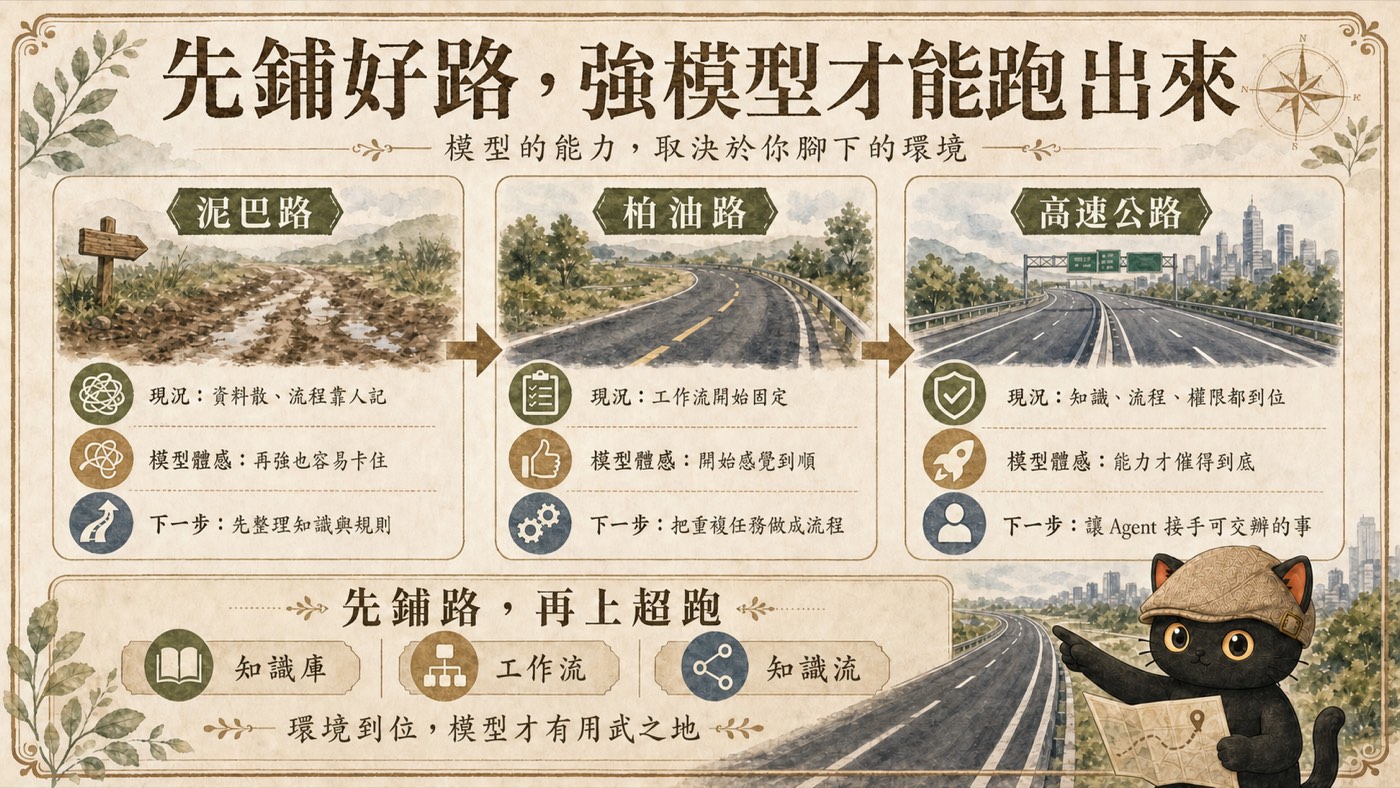
When a new generation of strong models like Claude Fable and GPT-5.6 Sol arrives, the first question most people ask is: should I upgrade now? Have I already missed the boat? I look at something else first. How far have you organized your knowledge base, workflow and knowledge flow? Put the same supercar on different road surfaces and it drives like two completely different cars.
Anthropic's Claude Fable and OpenAI's GPT-5.6 Sol take different approaches to capability and delivery. What they have in common is that the models are starting to handle longer, more complex knowledge work, research and tool use.
As models keep getting stronger, the documents, rules and workflows you have prepared will shape the final experience even more directly. Give two people the same strong model, and one can plug it into long-running tasks while the other can still only use it for one-off questions and answers.
Official information:Claude Fable 5 ↗ OpenAI GPT-5.6 ↗
When the automobile was first invented, its speed and reliability did not immediately beat the horse-drawn carriage. Some people only saw the comparison in front of them; others started to see another possibility: cars would keep improving, and the roads would change along with them.
When the road is still mud and gravel, there is little felt difference between a slower car and a faster one. Once the surface becomes asphalt, a car's stability and speed start to show. And only when the highway appears does a supercar really have room to open up.
Data is scattered, versions are a mess, and the process lives only in your memory. The AI has to re-learn the context every time, and long tasks get stuck easily.
Documents are centralized, templates are fixed, and inputs and outputs are clear. The AI doesn't have to understand you from scratch every time.
Data, knowledge, rules, permissions, acceptance and write-back connect into a road that can run continuously.
You can still use AI on a dirt road. General Q&A, one-off edits and summaries can still be done quickly. The trouble starts when tasks get longer, data piles up, and the judgment calls get more complex.
Here, the model can only guess its way across loose ground. A stronger model does guess right more often. But without the data, rules and goals, it still doesn't have enough to work with.
The key to the asphalt road is to spare the AI from having to understand you from scratch every time.
Each project has a fixed folder, and the latest version of important material can be found.
Each type of work has a template, a set of steps or a checklist.
The AI knows where the input is, where the output goes, and which step needs human confirmation.
At this level, articles, presentations, meeting notes and research reports start to form stable workflows. When you upgrade the model, the difference is easier to feel, because the task already has a clear route.
The AI knows where to get facts and materials.
The AI can see what has been done before, and the reasoning behind those calls.
The AI knows what it can do on its own and what it must stop to confirm.
Tasks have clear inputs, steps, outputs and handover methods.
When done, you can check the files, format, links, numbers and status.
New judgments and lessons get written back into the knowledge base or rule base.
Once these structures are connected, the AI has a chance to move from answering questions to taking over a whole stretch of work.
I started using Obsidian in 2024 and, over time, worked my way up to Harnessing Engineering and Loop Engineering. That journey has left me more and more sure of one thing: tools can be swapped out, but your own documents have to keep accumulating.
If your documents use common formats like Markdown, plain text or CSV, the cost of moving is usually lower. Switch to a different AI, a different Agent or a different note-taking tool, and the content you already organized can still be used.
Facts, materials, experience and judgment, with structure left behind through folders, naming and links.
Rules spell out the boundaries; processes spell out how to start, finish and check the work.
Articles, meetings, presentations, social-media reposting or project reports. Only work that happens repeatedly is worth paving a road for.
Confirm where the facts come from, which version is the latest, and where the result goes when you're done.
Write down the project goals, audience, preferred terms, banned terms, where the data lives, and what "done" looks like.
Then add human confirmation points, red lines and acceptance criteria that can actually be checked.
Watch where the AI misreads things, misses data or gets the order wrong. Don't rush to go fully automatic.
Fold the gaps back into the instructions, glossary, process or acceptance checklist so the next round runs smoother.
This is what I call Loop Engineering: input, execution, acceptance, correction, recording, then on to the next round. Each round makes the road a little smoother.
Please help me take stock of this task and judge whether it currently looks more like a dirt road, an asphalt road, or a highway.

Task name: [fill in]
Documents and data sources currently used: [fill in]
Current approach: [fill in]
Deliverable to produce when done: [fill in]

Please work through the following in order:
1. Identify the places where data sources are unclear, versions are a mess, or context is missing.
2. Find the judgments and steps that exist only in my head and haven't been written down yet.
3. Organize the task into inputs, steps, outputs, human confirmation points and acceptance criteria.
4. Suggest the minimum set of documents I need to add or organize.
5. List the parts to hand to the AI in the first round, and the parts to keep handling manually for now.
6. Finally, give me a minimal road-paving checklist I can finish within seven days.

Don't build full automation for me outright. First lay out the current state, the gaps, and the smallest next step clearly.
Organizing the environment cuts down on the model's guessing, makes tasks steadier and easier to repeat, and makes it easier to switch tools. It does not guarantee that every output is correct.
Once the road is paved, a human still has to decide the destination, the traffic rules, and when to hit the brakes.
Stronger models are worth looking forward to. As models improve, the amount of work we can hand off really does grow.
What truly accumulates over the long term is your own documents, knowledge, rules and workflow. While you're still on a dirt road, start by organizing one recurring task. Once the asphalt is laid, add the human confirmation points and acceptance criteria. And once knowledge, processes, permissions and write-back are all connected, let a stronger Agent take over longer tasks.
Tacit knowledge distiller and AI application planner. I keep organizing hands-on methods for AI × knowledge management, Harnessing Engineering and Loop Engineering.
If you want to organize your knowledge into a system that AI can actually help with, a good place to start is my knowledge architecture.
Two free talks each month, sharing hands-on experience and methodology.
Join the LINE community ↗