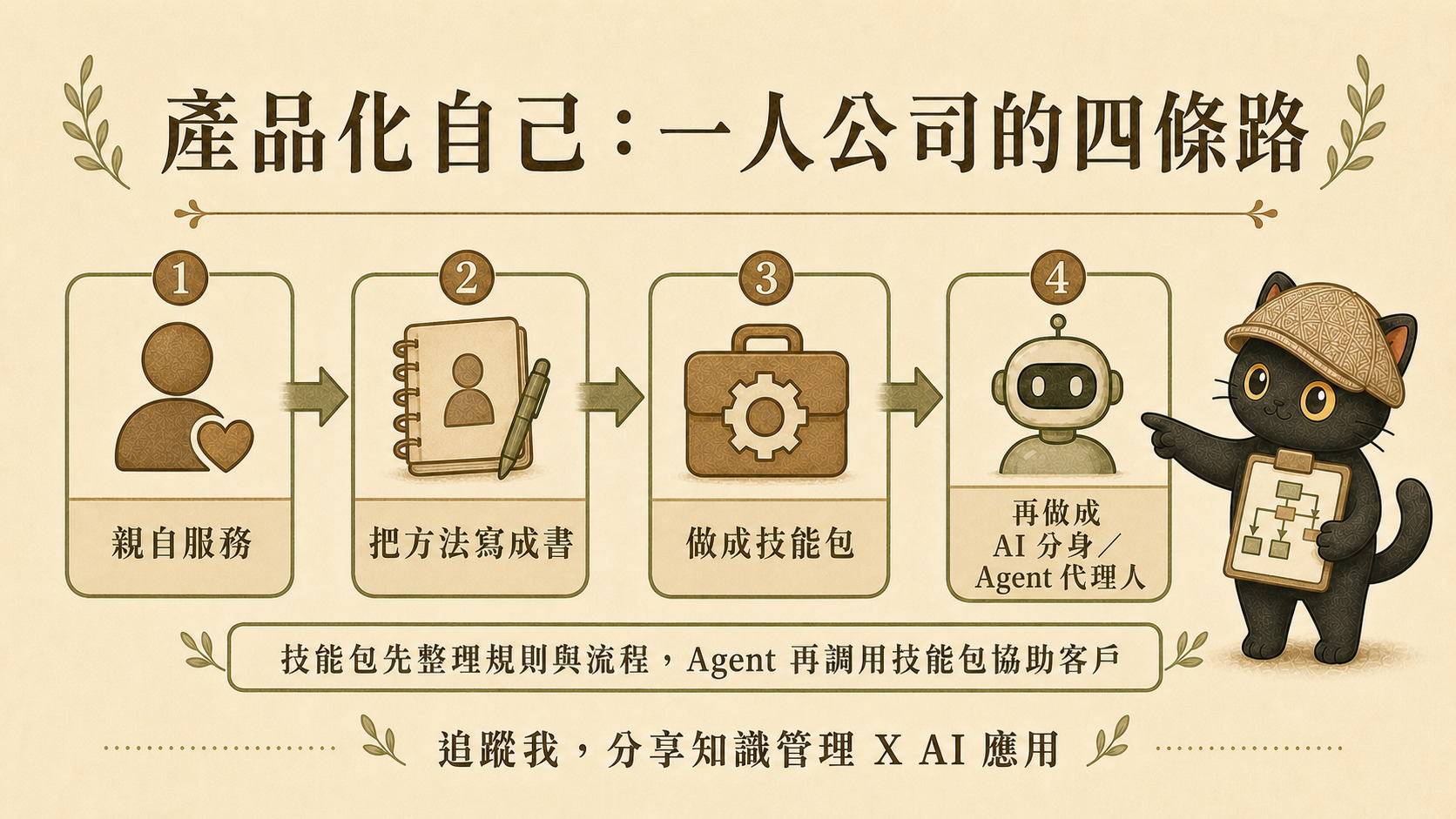
What This Article Is About
A personal studio and a one-person company may both appear to have only one person. I think the real difference involves two things. One is whether the income mainly depends on personal time and physical effort, or if the person has already been productized. The second point concerns whether this business mainly responds to the market, consumers, and shareholders, or if it primarily aims to realize the founder's own ideas.
- Already established a personal studio, but income is still mainly from personal case acceptance
- Want to turn your expertise into a product or service that can be sold repeatedly
- Want to use a digital avatar and skill package to productize yourself
- Judge whether income is still tied to personal working time
- Five-step method to turn your expertise into a book, video, AI avatar, or skill package
- Three directly usable skill packages and AI advisors
Two models, difference in how income is generated
Use your time, physical effort, and professional skills to complete one task after another. Earn money for each job done. When work pauses, income usually decreases as well.
First spend time building a business model, product, or service, then let this system repeat sales and delivery. Income is no longer entirely calculated based on each hour of personal work.
Looking at a teacher's work
A teacher earns 2,000 NT dollars per hour for private tutoring or accepts an invitation to give a class, mainly selling the teaching service at that moment. Even if the teaching materials can be reused, the actual delivery still requires the teacher to be present on-site.
The same teacher can also turn the teaching content into an online course. After filming the video and designing the purchase process, students who come in at different times can pay to learn independently, and the same content can serve more people at the same time.
Solo company: first build a product or system × repeat sales and delivery
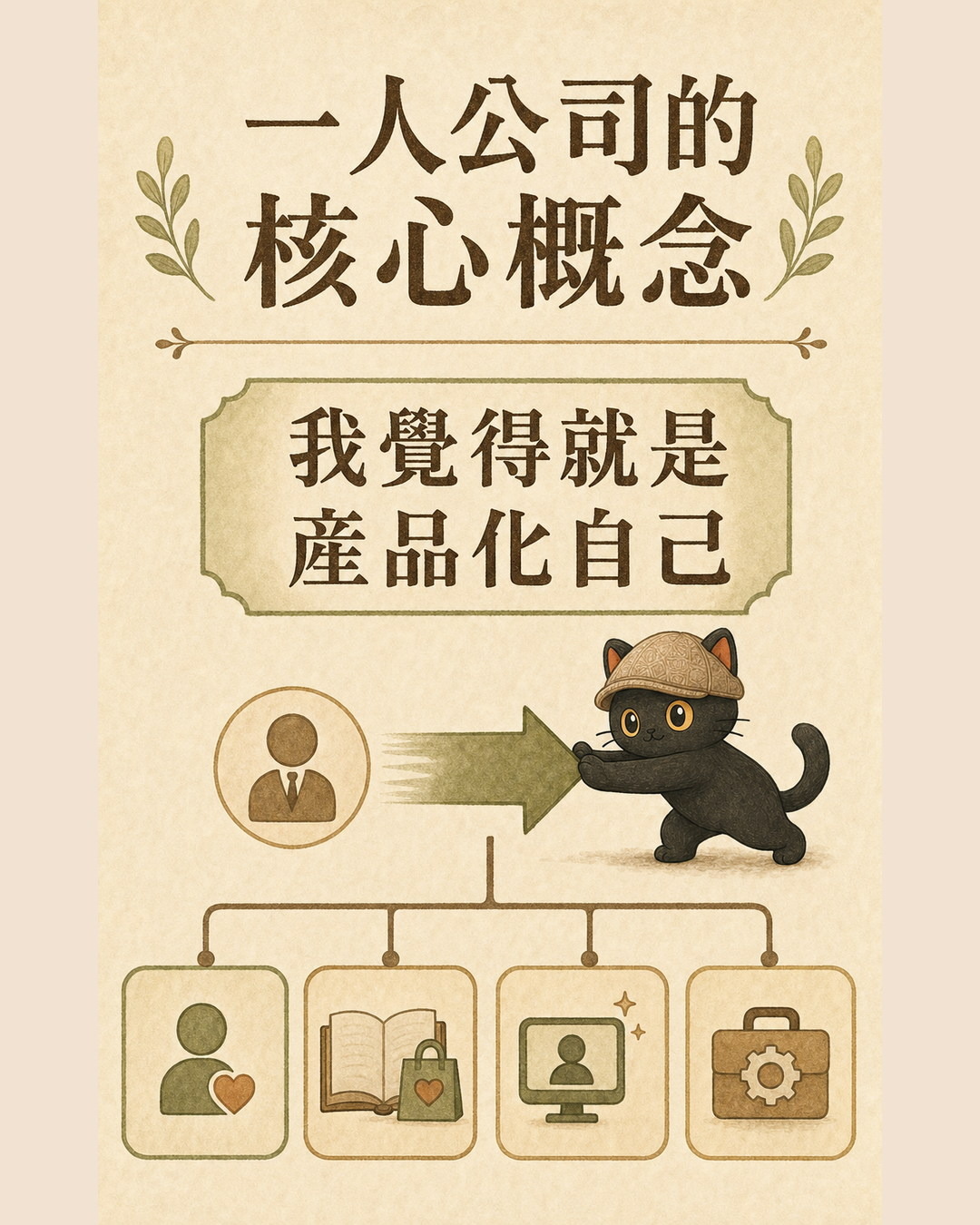
The core of a solo company: productizing oneself
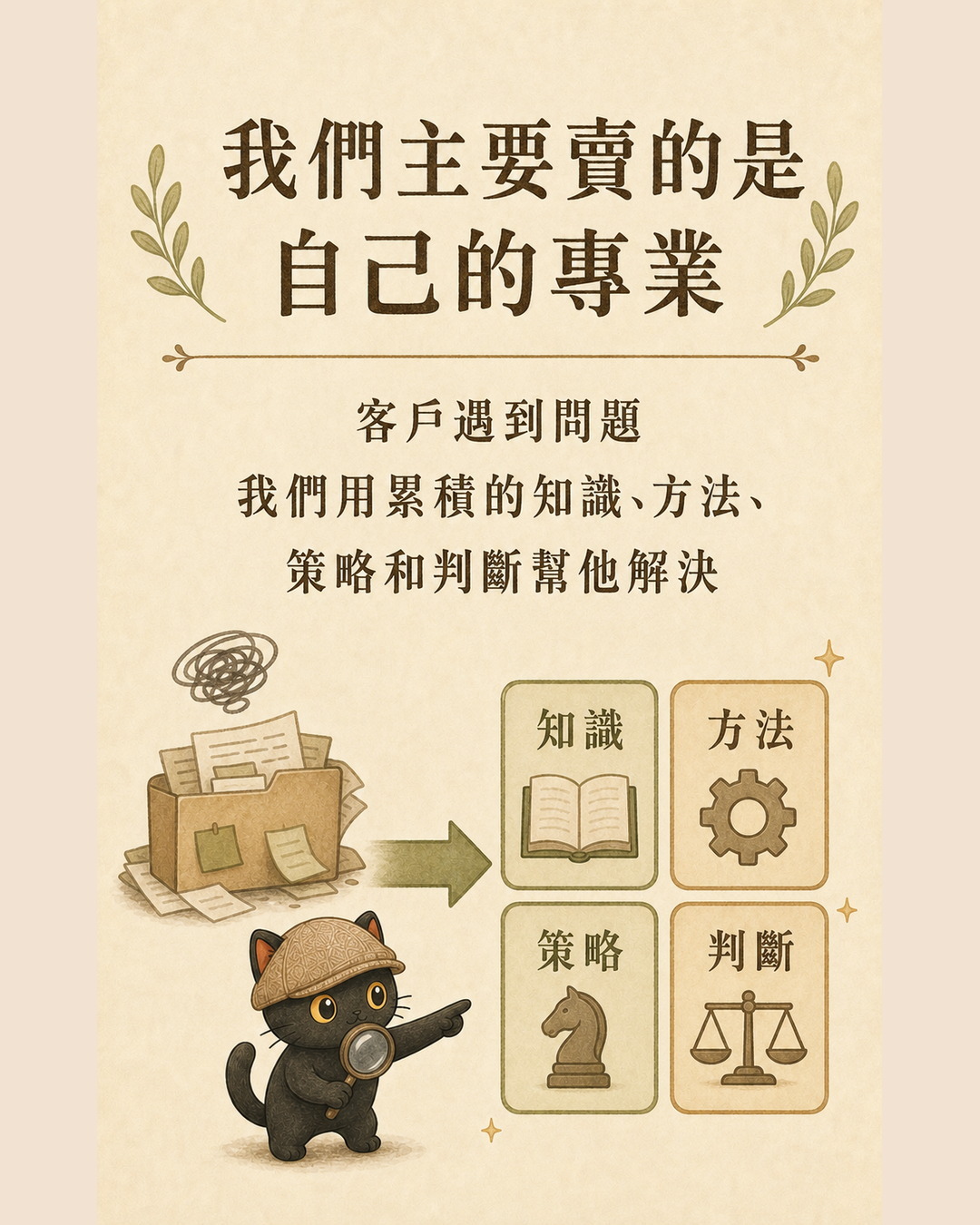
What we truly offer to customers is usually our own professional skills. When customers encounter problems, we use our accumulated knowledge, methods, strategies, and judgment to help them find solutions.
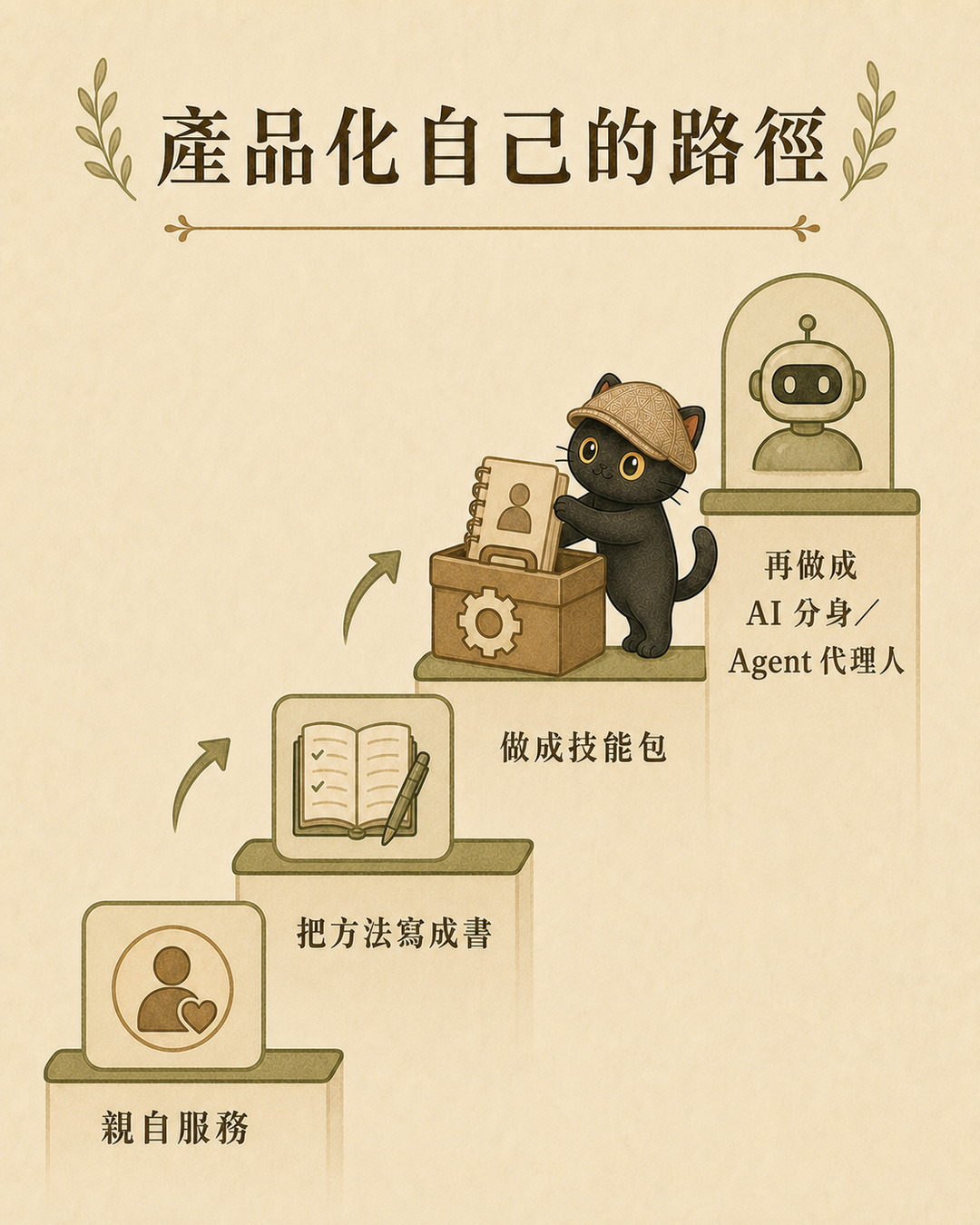
The most direct way is for me to personally spend time solving the customer's problem. Then, I can also write down my methods and strategies into a book or make a teaching video, allowing customers to use my methods through reading and learning.
I personally use my professional skills to directly solve the customer's problem.
Teach the customer the method, allowing them to understand and learn how to use it.
Hand over the judgment and process to AI, and accompany the customer in actual execution.
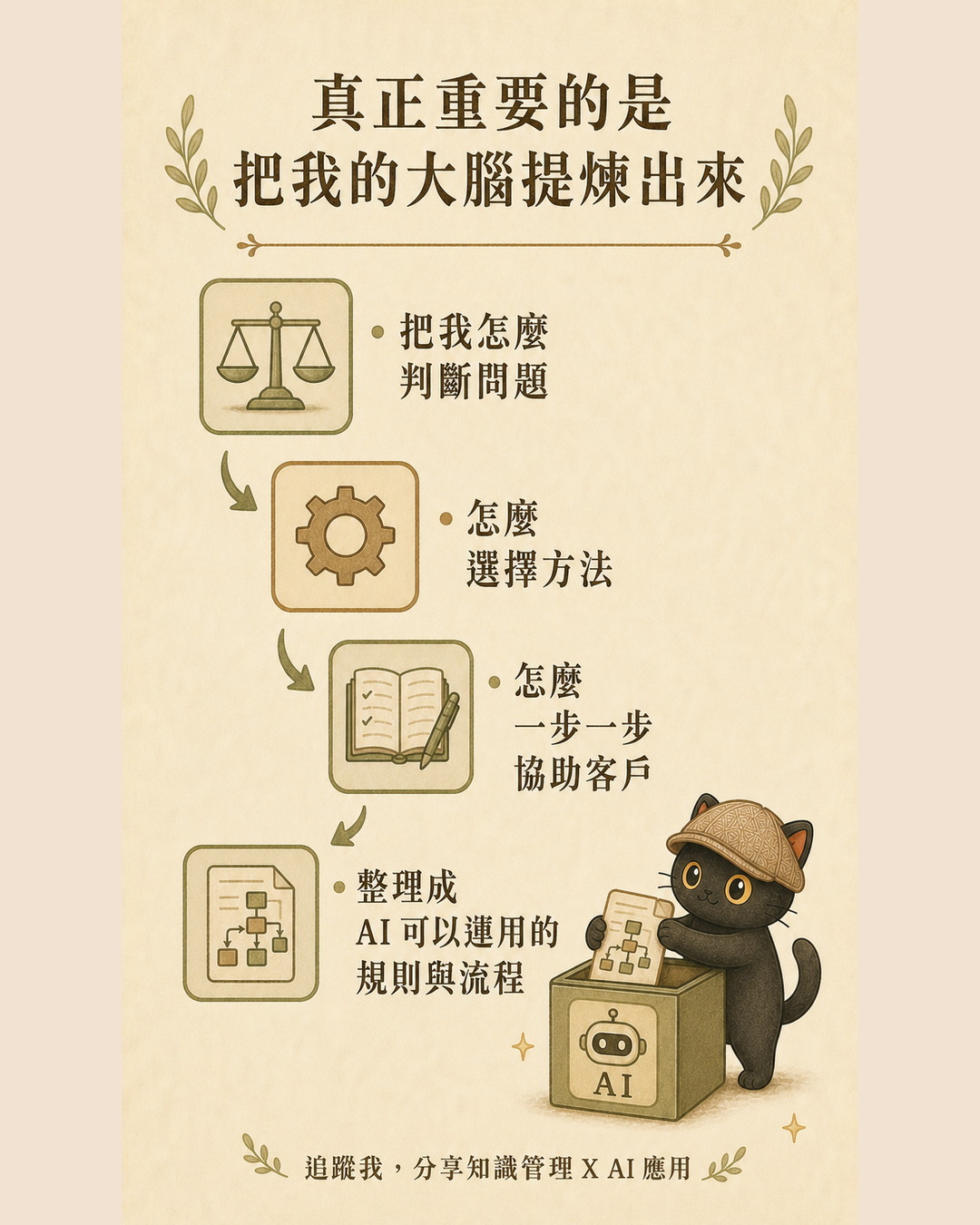
Here, the AI avatar refers to distilling your brain: organizing how to judge problems, how to choose methods, and how to step by step assist customers into rules and processes that AI can use.
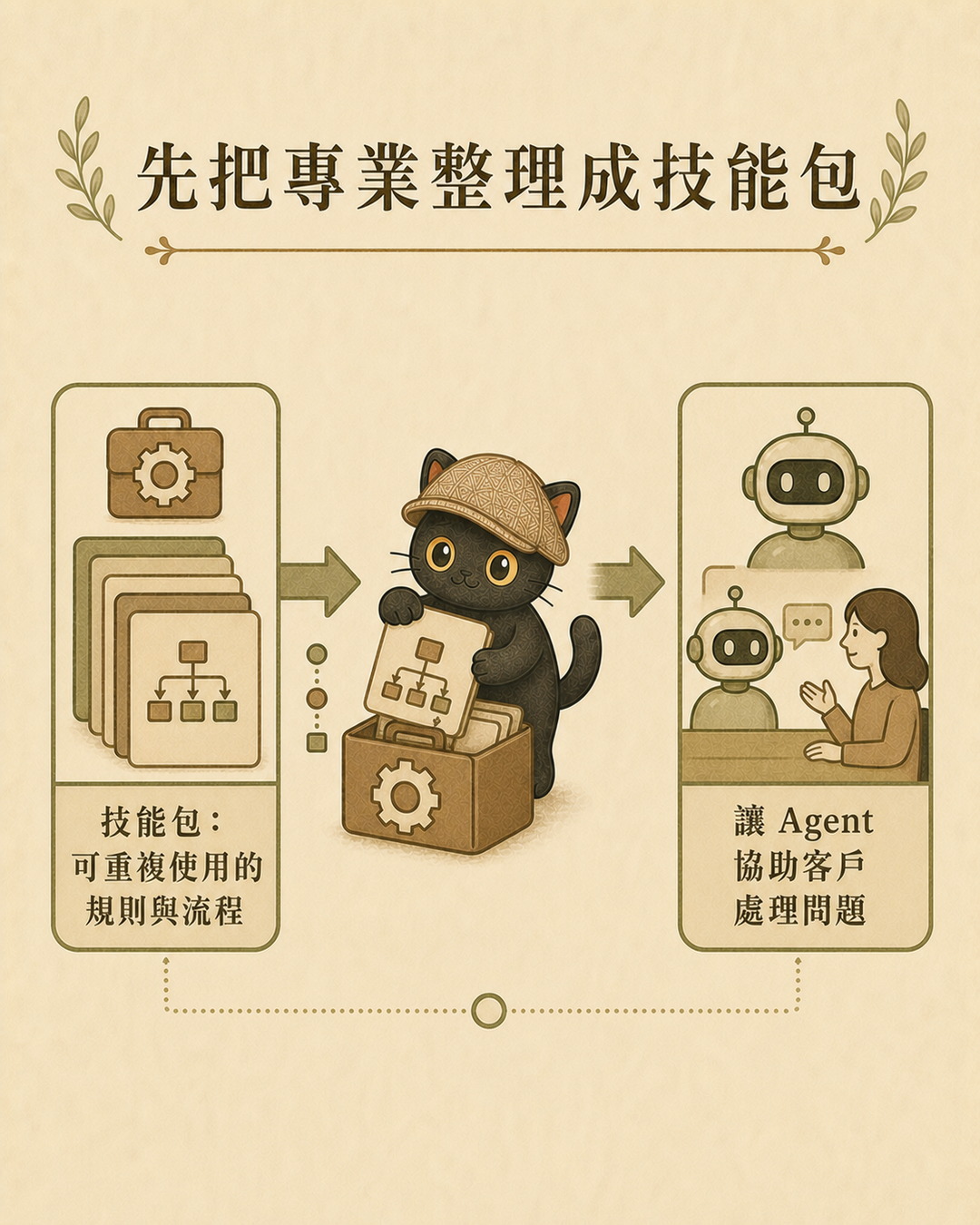
Books and videos mainly let customers learn your methods. AI avatars and skill packages further let this method accompany customers in execution. Our productized content includes professional judgment and problem-solving processes.
How to start productizing yourself?
According to the previous logic, I will summarize it into five steps.
Look back at the problems customers often bring to you, and pick out the ones you have really solved and that recur.
Write down what to ask first, which data to look at, how to judge, which methods to use, and what to deliver finally.
Organize what situations use which methods, when to change direction, which errors to avoid, and how to know when it's complete.
Based on customer needs for understanding, learning, or direct execution, choose books, videos, skill packages, or AI avatars.
Test whether the product can understand the context, choose methods, and deliver useful results, then write back the missing judgments.
Three direct entry points
Organize your articles, lecture transcripts, ideas, and decision-making cases into an AI advisor with sources, boundaries, and the ability to continuously verify.
View the skill package ↗Used to discuss what your exclusive knowledge is, which abilities are worth productizing, and how to use media and code leverage.
View Naval's digital twin on the official website →A more core comparison: who this service is for
Generally, when people start a company, they mainly serve the market, consumers, and shareholders. The company first looks at what the market lacks, what consumers are willing to buy, and what shareholders expect the company to grow into, then decides what products and services to offer.
What the market needs → what consumers are willing to buy → what the company provides
What I want to solve or achieve → what products and services I can create → who else needs this
The 'around myself' mentioned here does not mean completely ignoring the market. The product still needs someone to buy it. The difference is that this company was originally created for whom, and ultimately aims to complete whose idea.
Musk is an extreme example in my mind
According to this definition, I would consider Musk an extreme case of a one-person company.
His company is large in scale, with shareholders, customers, and many employees, and the organizational structure is certainly not what is generally referred to as a one-person company. However, from the founder's perspective, his products, technology, and business model all revolve around his long-term goal of the Mars and space plan.
A company can be large in scale while still having a very strong founder direction. The company serves the market, consumers, and shareholders, and also carries out the founder's own plan.
Used to check your goals, facts, assumptions, hard limits, and which minimum validation you can do first.
Use the First Principles Advisor on the official website →Finally, explain clearly in two sentences
Personal studio (personal freelance), is completing one piece of work with your time and professional expertise.
A one-person company, is productizing your professional expertise and ideas into a system that can operate repeatedly, and this system mainly aims to achieve what you truly want to complete.
First find a problem you repeatedly solve for clients, then record the real process and professional judgment. This is the starting point of productizing yourself.
Start distilling your own AI advisor ↗