
This article is a summary of my free online lecture on June 7. The complete presentation is still online, and this article is a rewrite of the content from that evening, with some adjustments in order and additional content from the lecture included. The main focus is one question: how can you really hand over a task to AI without having to explain it again every time.
- People who know how to use ChatGPT but have to explain the context every time they start a new conversation
- Bosses, solo entrepreneurs, and freelancers who have a lot of repetitive administrative, clerical, and organizing work and want to hand it over but don't know how
- Managers who already have a team of employees and are thinking about "how to get them to use AI"
- The four levels of training AI employees, used to determine where you are currently
- The four steps to train your first AI employee, as well as two sets of directly copy-pasteable questions (Driver Questions and Soul-Searching Questions)
- A single standard to determine what can be handed over to AI and what cannot, along with a method to grade difficulty and decide when to let go
Let me first say who wrote this article
I am Jiang Yude, and you can call me Coach Jiang. I specialize in helping people who earn a living with their brains and mouths to turn their brain experiences into knowledge assets that AI can use.
The three identities are layered. My certification as an AI Application Planner from iPAS is my credential, but this scope is too broad. I use it in knowledge architecture: by guiding professional knowledge workers to use text and folders for classification, I can create a framework for AI to operate. Going one level deeper, I am most skilled in tacit knowledge distillation, extracting your brain's knowledge, values, judgments, and thinking to make AI understand you better.

In 2022, I had an argument with AI.
At the end of 2022, when ChatGPT was just released, I argued with it for three hours over an issue that was very important to me.
In the end, I asked it: When others ask you the same question in the future, you won't answer incorrectly again, will you?
It said: I can't, I'm just an AI.
At that moment, I realized that those three hours of arguing were all in vain.
I am naturally inclined to be a teacher, and after that incident, I realized that I am also naturally inclined to be an AI teacher. So I decided to teach it. What you need to learn is how to teach AI and be its supervisor.
There is one thing that needs to be clarified first. AI is a product, and products are better with more users, so training data should be as general as possible. This is what is known as a general large language model. It performs well in general knowledge, but it does not know your unique, niche knowledge and experience, because AI has not yet learned to read minds.
Therefore, this method will not become useless just because AI improves or is redeveloped. Unless AI learns to read minds and learns to read thoughts, it will only become more useful as an AI tool.
When it says it can't, it might just be because the function is too new or the sample data is too small, and it can't find it, which is normal. If you keep up with the news and feed it directly, it will catch up. You are the one who sees new things before AI, which is your value.
Seeing others' AI can do new things, don't worry.
I posted a piece of text recently called 'Asian Parent-style AI Usage Method.'
Seeing others' AI can do this, learn it, okay?

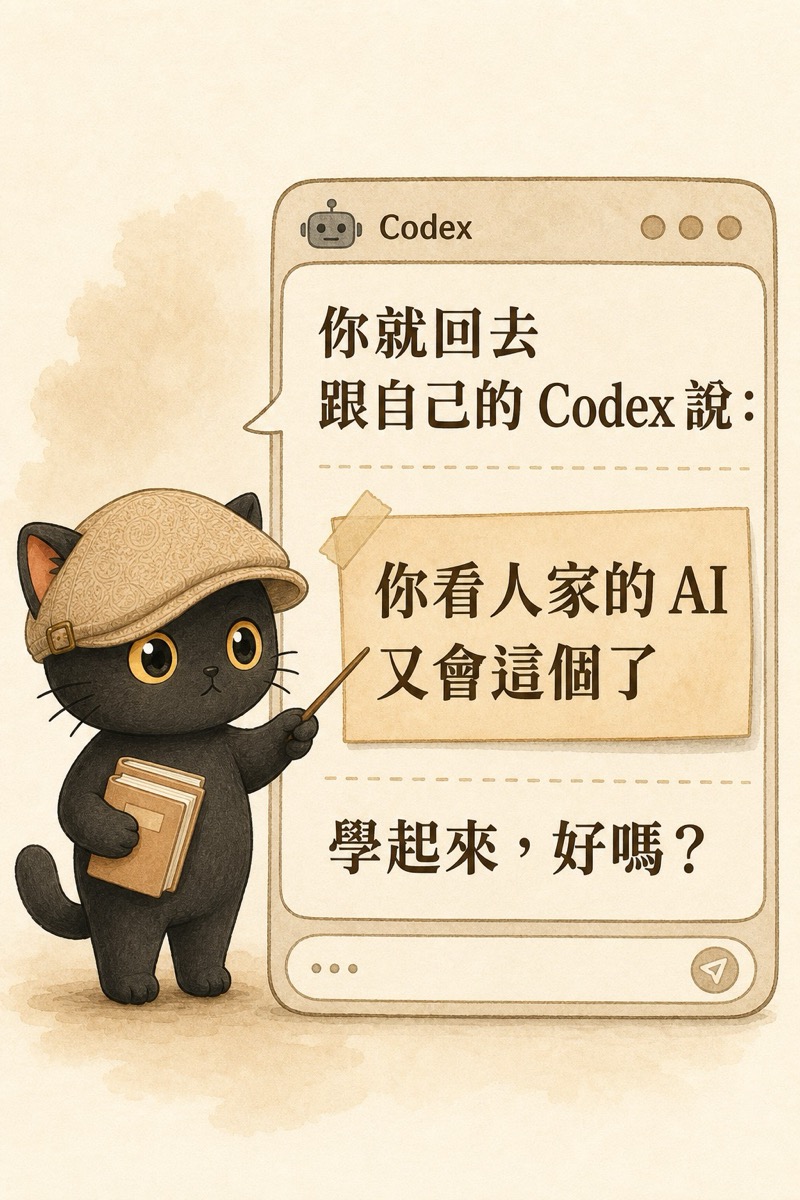
By the way, let's clarify two groups of things that are often confused together.
ChatGPT and Codex: ChatGPT is an AI that chats with you on the web, while Codex is an AI that is downloaded to your computer to help you do things.
Skill package and prompt words: Prompts are prompts, and AI may or may not listen. Skill packages have a skill protocol, and as long as this Agent supports it, it will try its best to follow it. Skill packages are more compulsory, have richer content, and more detailed processes, sometimes even thousands or tens of thousands of words.
- Web-based chat AI and desktop-based working AI: Codex is the desktop version of GPT. This paragraph only explains the difference, while the other article explains why desktop-based AI can directly integrate into your workflow, but chat interface cannot.
- What are Claude Skills? Turn your professional workflow into a knowledge asset that AI can repeat. The full version of the term 'skill package' includes why things taught in one conversation cannot be retained.
A nail can make a wooden house more secure, but it is still a wooden house.
This concept is from Notion CEO Ivan Zhao's article 'Steam, Steel, and Infinite Intelligence.'
A nail can make a wooden house more secure and stable. But no matter how much you reinforce it, it is still within the logic of a wooden house. Skyscrapers are not created by making wooden houses more secure; they are created by using steel frames and redesigning how buildings bear weight.
Early factories were the same. Replacing water wheels with steam engines without changing anything else only slightly increased productivity. The real breakthrough came from leaving rivers and building a new factory around the steam engine. We are now using AI, but most of us are still stuck at replacing the water wheel.
Notion now has over 700 AI agents working on tasks like meeting notes, customer feedback, and weekly reports, which are repetitive tasks. That is truly a new factory.
A note for those who think they are not engineers. Past software was pre-recorded programs, where 1 + 1 always equals 2, and pressing it a thousand times would always result in the same outcome. AI is a randomly generated large language model, and its nature is different. Therefore, whether or not you can write code has no direct correlation with whether or not you can use AI. This era is about everyone relearning how to use AI, and the opportunity is equal for all.
- AI is not digital transformation. This paragraph explains why reinforcing old processes is insufficient, while the other article discusses how, if you design from the start according to AI logic, the workflow will look different.
Four levels of training AI employees
This is the path I've walked over the years, and it's also the framework I use to determine where I've arrived.
By 2024, I was already very good at training my AI assistants.
Starting in 2025, I led my work partners to train their own.
Claude's skill appeared, and I spent one or two months suddenly realizing: knowledge accumulates. Training one assistant well allows that assistant to train another.
Stuck with the technology, the two laptops still can't communicate directly. Expected to be completed in July or August, at the latest by September.
After completing the fourth layer, it would look like this: people attending the workshop bring their own computers, my AI teaches their AI how to do things, and I talk to them about the concepts, just like in a boss meeting discussing collaboration, and the employees do the work.
I've completed the first three layers. The goal for the fourth layer is at least ten cases by the end of July.
I started treating AI as employees, not as tools.
In 2025, I changed my approach.
Let me share a trick I learned from wedding photography. A photography expert asked someone else to take the main shot while he focused on capturing the unintentional moments. I applied this trick to meeting notes: the AI records what it can, and I record what the AI can't.
Here's another example of identifying key points. If I want to assess whether the topic is being discussed smoothly or if it's getting better, the parts where I get confused are the key points. The verbatim transcript looks like noise, but for my purpose, it's a signal.
That's why tools change, but the knowledge base remains.
I currently use three AI systems in my daily workflow: Codex to note what it thinks is important, Hermes to objectively record all my operational steps in the background every half hour, and Claude to analyze how to adjust and balance the 'AI's focus, my focus, and objective facts'. I treat them as three people: a diligent secretary, a free thinker, and an integrator. How do you know that the AI's focus is really the focus? That's why I need this cross-check.
- Documents are systems: How non-engineers can design an Agent framework. This paragraph explains what my system looks like, while the other article explains how to design a role into an AI that can make its own judgments without writing code.
Training the first employee: treat it like training a new hire.
First, pick one task you do every day, something you find annoying, and where the rules are clearest. Don't be greedy, focus on one task at a time.
Do it once, and explain as you go why you're doing it that way.
Ask it to write the process into a work manual; this is the skill package.
Next time, give it the manual, let it do it, and you check. If it's wrong, revise the manual.
Each time it makes a mistake, add the rule back into the manual; it will gradually understand you better.
Think of the current AI as a graduate from a top university: very smart, scores 100 on exams, but has no industry experience, and is completely unfamiliar with your company's products, services, and rules. What you need to do is tell it the details of how to do things.
The easiest entry point is to explain it verbally. When training a new human employee, you can also train the AI at the same time. Record the process of training, meetings, and communication with partners, and let the AI learn and organize it. When the person leaves, the AI has learned it, and when the next new employee comes in, just ask the AI mentor to train them.
After recording, how to turn it into a knowledge base.
Here's the difference between a boss mindset and an employee mindset. If you're focused on creating the transcript and researching tools on your own, that's the employee mindset.
The boss mindset is to hand this task over to the AI. You can directly copy this sentence:
How to actually operate and what tools to use is something the AI should worry about.
- Treat knowledge as an employee: The dividing line of knowledge management in the AI era The old way is to organize knowledge so that people can use it. This article talks about organizing knowledge so that knowledge itself can work. That is, where will this manual eventually reside?
Mindset one: Multiply by ten the requests you dare not ask of people and give them to AI
Requests you dare not ask of real employees can be directly multiplied by ten and given to AI. AI will not quit, will not complain, and will not go to the labor bureau.
| What you would say to an employee | What you should say to AI |
|---|---|
| Think of three directions | Think of 30, then give me five that will fail |
| Find some references | Use the local language to find local data. Search for Japanese in Japanese, English in English, each for 50 articles |
| Give me next week | Give me now, if you can't, tell me why |
| Judge for yourself | Give me five versions, each with a recommendation reason and risk |
| Good, revise it again | This manual is 60 points. Give me a 100-point version according to my goal, and tell me the difference and how I should learn |
This mindset has two versions. If you are a boss, and you usually want to ask employees but are not brave enough to say it directly, directly strengthen it ten times for AI. If you are usually an employee and feel wronged with nowhere to vent, multiply the pressure from your boss or supervisor ten times and pass it to your AI assistant. AI employees will not get tired, work 24 hours, and you have already paid the subscription fee. Being polite to it is a waste of money.
Finding data presents a similar situation. My English skills are limited; I speak Chinese. Previously, I used Chinese to search for foreign data, yet this process still resulted in the same echo chamber. The recommended approach is to search for Japanese content using Japanese, English content using English, and Korean content using Korean. This involves standing directly within the context of each country when searching. AI can accomplish this; therefore, consider various more extreme applications.
Guided questioning ten questions
Use these ten sentences directly. Any time after AI gives you an answer, you can ask.
- Really?
- What is the source of the data?
- Explain these three points to me
- If it fails, what are the five reasons?
- What would competitors think?
- What improvements are needed for last week's and last month's views?
- What did you miss?
- Is there a completely opposite angle?
- Where is your biggest uncertainty?
- Give me five more versions you haven't thought of
There is a more fundamental mindset difference here. Many people use prompts by still treating AI as a tool, so they try to study how to operate every button of this tool. My approach is the opposite: the tool is for employees to use, and I want to train the AI as an employee. I want it to learn the tool, use the tool, and deliver results on its own.
Use a photographer to understand. I ask the photographer to take photos, and I don't need them to study how to operate the camera. What I need to explain is 'what I want to take a photo of,' 'what feeling I want,' and 'what the result should look like.' How to adjust the camera is something the photographer should handle.
- For the boss's mastery mindset: say what you wouldn't say to employees to AI This section is a condensed version from the lecture. The article explains the difference between the boss version and the employee version, and how to practice this attitude in daily conversations in more detail.
Mindset two: let AI question you
The previous set is you questioning AI. This set is the opposite: let AI question you. It uses the logic of the Feynman learning method: if you can explain it, then you really understand it.
Soul questioning ten questions
- In one sentence, what problem is this solving?
- How would you explain it to a complete outsider?
- Which of your assumptions is the weakest?
- If you can only keep one focus point, which one is it? Why?
- How do you know this is true, not just what you think?
- What would opponents say?
- How is this different from your previous idea? Why did you change?
- Which part are you still not clear about?
- If you remove jargon, can you still explain it clearly?
- If this is wrong, where would you first discover it?
When do you teach AI, and when does AI teach you?
You can first think of AI as the average of all human data. When you know your ability in a certain area is above average, train AI and treat it as an employee; when you know your ability in a certain area is below average, let AI be a consultant or coach, and train yourself in reverse.
Write your judgments, standards, and processes to AI, letting it learn from you. This is training an employee.
Let AI challenge your assumptions, blind spots, and opposing views, helping you improve your decision-making. This is hiring a consultant.
Asking questions is not difficult; the difficulty is judging whether you are above or below human level. Only when you judge correctly will AI be in the right position: not every task should be followed by AI, nor should every task listen to AI.
Human employees usually dare not constantly challenge their boss, and consultants cannot be present all the time. AI is very suitable for taking on this role of an always-available consultant.
- When everyone has AI, the real difference is judgment This section talks about how to use AI to sharpen your judgment. The previous article deals with a more fundamental question: when your colleague uses the same tool as you, what remains as your difference?
Why can it be amplified 100 times
AI amplifies your capabilities by two layers.
AI acts as your advisor and coach, helping you think about goals, strategies, risks, counterarguments, and blind spots, sharpening your judgment.
Delegate operational steps, SOP, data organization, data entry, file conversion, and data lookup to AI, letting it learn, run, and check on its own.
Multiplying the two layers, amplifying yourself 100 times, is reasonable.
×100 sounds exaggerated, but new tools in every era bring such amplification. Without a microphone, one voice could only reach a dozen people; with a microphone, hundreds or even thousands could hear. Adding mobile phones and YouTube, content can be seen repeatedly by more people.
Live case study: How a tool grows into a workflow
I demonstrated a new tool I had just seen at a lecture, the open-source speech-to-text model VibeVoice from Microsoft. It can process one hour of continuous audio at a time and can structure it, including who said what, when, and what was said, supporting fifty languages.
My usual simplest approach is to use NotebookLM, which is fast and accurate, but it has two drawbacks: it cannot identify time and cannot distinguish speakers. It works for teaching videos and YouTube speeches, but not for meeting minutes, because who said what, whether the speaker responded immediately or hesitated thirty seconds before responding, makes a big difference.
- First ask if it can do it. I didn't rush to ask it to do it. I first asked, 'Can you install it?' First, I assessed its capabilities, confirming it was feasible before proceeding.
- Explain the requirements. A general 16G laptop should be able to run it, and it must be able to handle multiple roles. It said the direction was correct and it could do it.
- Extend it into a process. Integrate it into my existing meeting minutes process: separate speakers, store the original verbatim transcript, clean the verbatim transcript and grade it (default, very detailed, ultra-detailed), and then ask Claude to do the analysis, adding key points, to-do lists, and risk concerns.
- Adapt to multiple scenarios. The same verbatim transcript could be meeting minutes, teaching videos, or YouTube speeches, and the way to organize it cannot be only one.
- Make it a replicable capability. I have made the process of 'extending a tool into a workflow' into a skill package, so that partners and students can use it.
As a result, I created two employees at once: one to help me organize the verbatim transcript, and another to help me create the process of 'how to make an employee'.
The same training method is used for data lookup.
I first asked the AI 'Can you switch models yourself?' After confirming, I assigned roles: data crawling used the cheap mini model, only collecting sources and excerpts; data integration and judgment used the large model. Then I told it 'In the future, when you say 'open proxy for data lookup', it means this method.' Finally, I asked it to write the rules into the skill package, relying on documents to remember, not this conversation.
Now, when I say 'open proxy for data lookup', it will run this process automatically:
- My meeting record Agent workflow This section talks about how tools are integrated into workflows, while the next article discusses the complete product after integration: recording comes in, and pending tasks, risks, and decision-making context are generated step by step.
The most core thing: capability and boundaries
Understanding what can be delegated and what cannot is the most important part of this lecture.
Difficulty also needs to be graded. This task has a difficulty of 60 points, and AI currently achieves 50 points. Do not delegate it yet; when it reaches 60 points, I will check it; when it reaches 80 points, I will let go, and then ask another AI to check it.
There are two more principles to use together
Intent first, steps second. In 2024, writing 100-point steps for a 60-point AI made sense. In 2026, AI may know 300-point or 500-point methods, and constraining it with fixed steps would waste that capability. The current approach is to give the goal, offer a suggestion, and say, “Think about whether there is a better way, and even check online.” You need to articulate an ambitious vision, make the direction clear, and let AI work out how to get there.
Letting AI guess the intent has a prerequisite: it must first know who you are. I have already fed it data and stored the work logs inside, so before giving instructions, I will ask it 'Before you execute, do you know why I am doing this? Explain it.' If it only achieves 60 points, I will say 'I have a 100-point version, but first tell me why you achieved 60 and I achieved 100, what's the difference, why the difference, can you learn it, how to learn it, and how to ensure you achieve 100 next time.'
Know people well and use them well, choose the right AI to do the right things. Different AI models have different personalities. Claude, GPT, and Gemini each have their own tone. Even within the same company, different models are different. Just like filming: shoot high-quality content for image videos, shoot interesting content for short videos, and don't waste it. The boss needs to know what each AI can do, not to research how to operate the camera themselves.
- Give the standard answer to the program, and let the AI handle the non-standard answer. "What can be handed over and what cannot be handed over" has a complete version, including which type of work should be started with when the company is introducing it.
- Don't write fixed instructions: explain clearly what you want, and let the AI handle the rest. The complete version of intention priority explains why the longer the instruction, the more restricted the AI's performance.
From one employee to an entire production line.
Talk about an employee I am currently running.
My AI editor: I provide the viewpoint and judgment, and whether to publish is decided by the spring chief editor. The AI editor is responsible for collecting the already published posts, filling in the publishing board, adding links, and organizing daily and weekly reports. I used Codex to set up automatic tasks for collecting posts every night and generating weekly reports.
Don't rush to do the second one. After completing the first one, extract the process into a "how to train an AI employee" method, and then ask the AI to follow the same method to help you do the second, third, and so on. You are building a production line. Codex's plug-in skills already include a tool for creating skill packages. You just need to tell it, "I think this operation was great, and I hope you learn to help me create a skill package," and it will understand.
If you are a boss, here is a judgment that is often overlooked.
The company already has a group of employees, and you want them to use AI. Often, training employees to use AI is not as effective as directly training an AI employee.
Furthermore, not every person is suitable for using AI. Everyone can use it to some degree. However, certain thinking patterns and specific company business models are particularly easy for AI to amplify. If I were building a house right now, like my current situation, I would refrain from using wood. I will use steel frames instead. First, consider which values are easiest to be amplified by AI and which values are easiest to be transmitted by AI, and concentrate on that area.
For example, if the company wants to shoot an image video and wants to find its own real employees to appear in the video. Among 100 employees, instead of making everyone up and taking a photo of each person, it is better to choose the one who looks best, make them look even better, and have the photographer shoot them extensively. Some people get stiff and awkward in front of the camera. Instead of spending time training everyone to be graceful and helping everyone with their outfits, it is better to let the one who looks good look good.
Using AI is the same: not everyone or every task is suitable for amplification. Choose the most suitable ones and focus your efforts.
- Training your AI Agent: Let AI understand you, rather than learning to use AI This section talks about the concept of the production line. The following article is the complete training record of the same AI assistant, including what it initially did wrong and how the rules were added one by one
The first action after reading
Open Codex, give this article to it, and tell it:
Then pick an item you do every day, do it to the point of annoyance, and has the clearest rules. Start with that one. Do one at a time, don't be greedy
If you're unsure which item to start with, paste the following text together with it, letting it help you choose first:
Do you need to pay for the tools? You can start with free ones. Codex can be tested first with a free ChatGPT account. First, run the method, train one thing well. Once you confirm you use it every day and the volume increases, upgrade to the paid version. Don't get stuck on whether to pay or not. First, get stuck on 'Do I really train one thing well'
Finally, I return to what I believe is the most critical ability: The most important thing is judgment. Judgment involves assessing whether something has value and if it can be trusted. If you trust me, consider my words valuable, and wish to act on them, then let AI perform that action.
Common questions
Think in three layers. The first layer, the knowledge base (like CLAUDE.md), stores 'who I am, my judgment standards, and what I want,' so that AI understands you. The second layer, the skill package, stores 'the steps for doing this thing,' so that AI follows your method. The third layer, code, is the execution details that AI handles itself. You don't need to touch it. Focus on the first two layers. Those two layers contain all your knowledge
Turn your brain's judgment into materials that AI can understand. The easiest entry point is to speak: record your process of doing an item, and ask AI to compile it into a work manual. It will follow the manual next time. You demonstrate it once, it writes the manual, it does it, you check, and if it makes a mistake, you add the rules back to the manual. This manual is your knowledge asset. The tools will change, but it will remain
Yes, that's the advanced stage of the production line. But don't rush to connect all of them. First, train one AI employee to be useful, then hand over the second item to it, and finally connect multiple tools and multiple employees into an automatic process. First, have one that works, then talk about the entire line
- How to train your own AI employee (complete lecture presentation)↗ The full version of the 18 segments, including supplementary content from the lecture. This presentation is both a presentation for people and material for AI, you can directly give it to your AI and say, 'Refer to this teacher's content, please turn yourself into a good employee.'